One of the biggest challenges for investors is accepting that nobody knows exactly what will happen next. While anticipation, forecasting and prediction comes naturally to investors, accepting inevitable uncertainty is central to disciplined investment. Economic growth may accelerate in the future, inflation could rise, interest rates might fall, or investors could simply take a different view about the future, affecting prices of investments today.
The future is impossible to predict, which is why we believe successful investing is not about positioning a portfolio for one specific outcome. Accepting that uncertainty is inevitable, portfolios should be built to withstand a range of market environments.
At the heart of this approach is diversification of investments through asset allocation. This refers to how we divide a portfolio across different asset classes, such as stocks (buying shares of companies), bonds (debt issued by companies or governments) and alternatives (e.g. property or infrastructure).
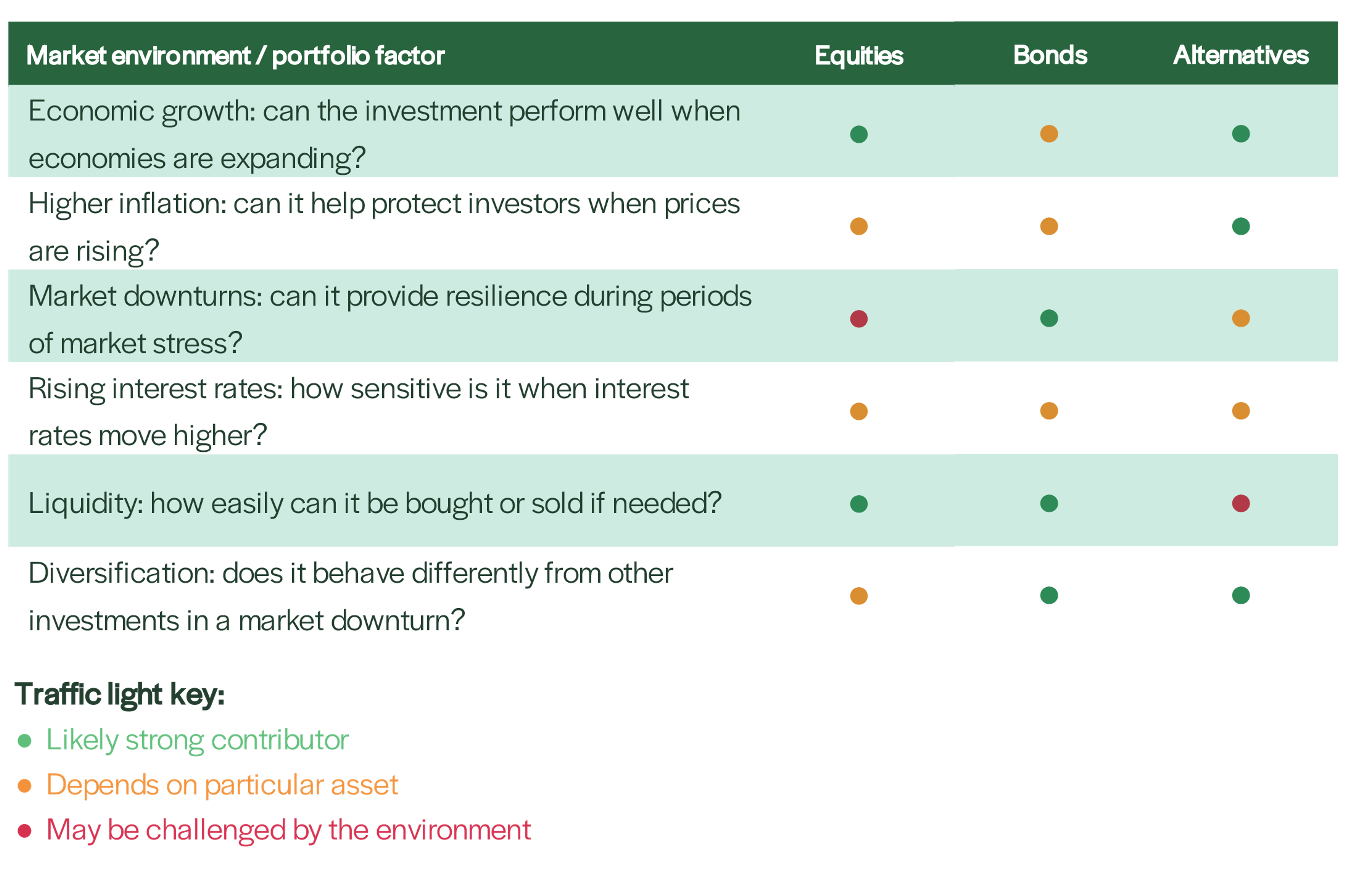
For confidence in successful long run investment outcomes, diversification remains one of the most powerful tools available to investors. Diversification is the concept of not putting all your eggs into one basket. For example, equities have historically been an important driver of returns when economic growth is strong and company profits are rising. Bonds can play a different role, helping to provide stability during more challenging periods when investors become more cautious on the strength of the economy. Alternative assets, such as infrastructure, can offer additional diversification of investment returns and may prove more resilient in environments where inflation remains elevated, which might be challenging for both stocks and bonds.
By combining multiple sources of return, portfolios become less reliant on any single future economic state or market outcome – creating more resilient portfolios to weather any market storms without sacrificing strong investment performance over the long run.
However, building a resilient portfolio involves more than simply selecting different asset classes. Portfolio construction is equally important. Once we have established the overall asset allocation, we carefully consider how the underlying investments in each asset class work together as part of a broader portfolio.
This means looking beyond individual investments and focusing on the bigger picture. Our aim is to ensure that each investment has a clear purpose and contributes something different to the overall portfolio.
What does this mean in practice? For example, two different funds may invest in different areas of the market, but still be exposed to many of the same risks. Equally, investments that appear similar on the surface can behave very differently when market conditions change.
By taking a total portfolio approach (TPA), which is our approach to portfolio construction and management where we seek to build portfolios where the different components complement one another. rather than considering each piece in isolation.
With the recent World Cup having showcased the importance of teamwork, it provides a useful way to think about the total portfolio approach. A successful team isn't built by picking eleven strikers because they're the best goal scorers. Instead, players are selected based on the role they play. Goalkeepers provide protection, defenders add stability, midfielders create balance and forwards drive attacking performance. The team's success depends on how the players work together, not on whether every player scores the most goals.
Ultimately, confidence should not come from believing that any one economic or market forecast will prove correct. Instead, it should come from knowing that a portfolio has been thoughtfully designed to cope with different scenarios.
Through a combination of asset allocation, careful portfolio construction, diversification and selective use of active management, we aim to build portfolios that can adapt as conditions change, helping investors stay focused on their long-term goals whatever the market environment.
The table below provides a simplified illustration of how different investments compete for a place in the portfolio. It highlights the role each asset class can play and how it may behave across a range of market environments, from periods of economic growth and rising inflation to market downturns and changing interest rates.