Source: MSCI, WTW
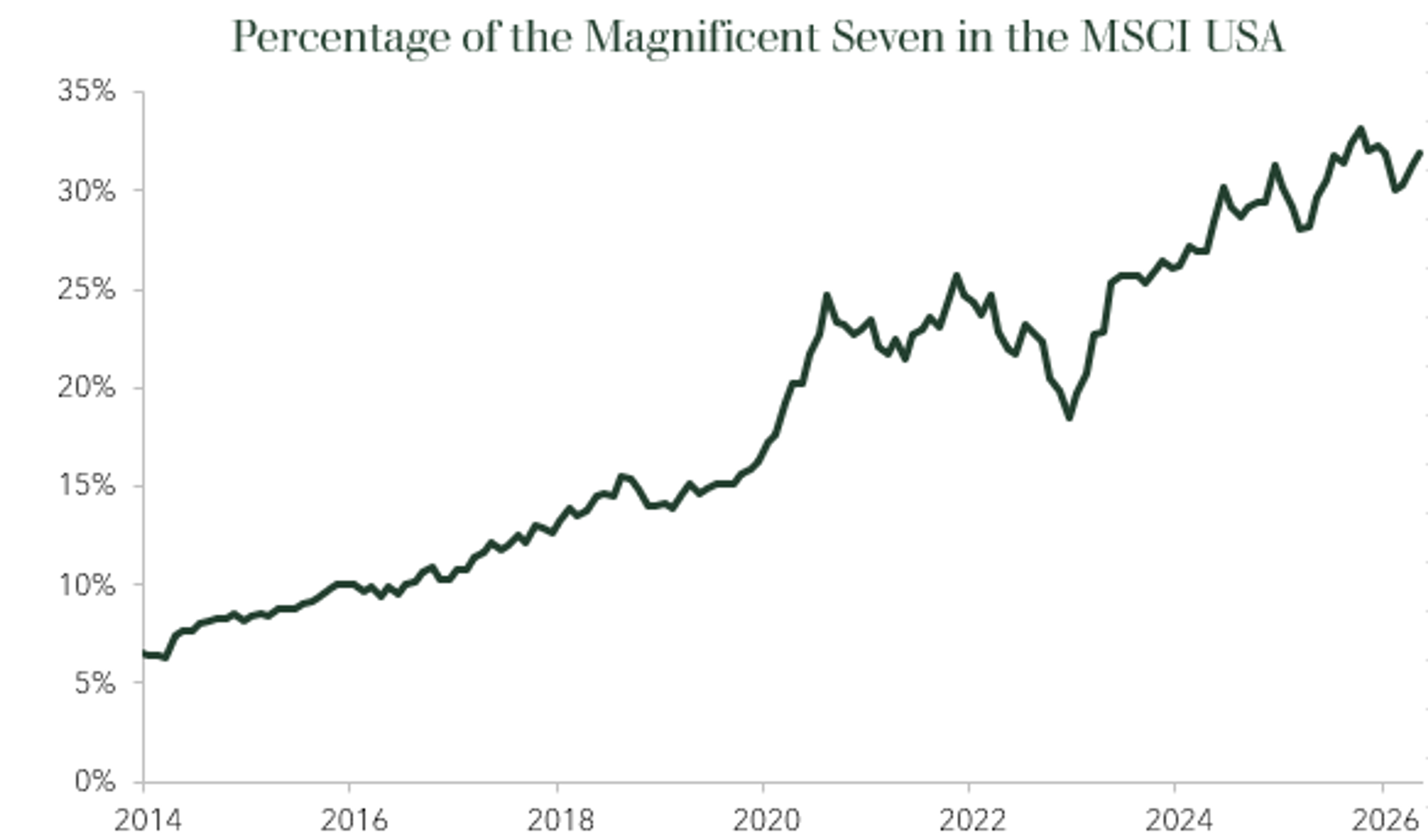
Do passive investors inflate the size of larger stocks? In our view, no. Prices move first, and index weights simply follow.
When companies perform well, and investors become more positive about their prospects, their share prices rise. As a result, their weight in an index increases automatically, but we note that passive investors tracking the index do not need to buy more of the stock. Once money is invested passively, little to no further trading is needed to follow the broad market index. (There are some more technical issues, such as stock dividends needing to be reinvested, and changes in index composition due to “free float” adjustments. These do not impact the conclusions.)
In other words, passive investment flows are not deciding which companies dominate markets. Passive investment is capturing the result of decisions already made across the market.
There is, however, a nuance. Because passive investment flows simply follow index weights, strong passive inflows can reinforce market trends that are already in place.
This does not create concentration, but it can potentially allow an investment trend to persist for longer than it otherwise might.
Does passive investing distort the value of companies in the market?
Another concern is that passive investing reduces the number of investors analysing companies, potentially weakening what economists call “price discovery”.
What exactly is “price discovery”? In simple terms, price discovery comes from investors weighing up new information about a company, such as a company’s earnings, growth prospects, risks, etc and deciding what they are willing to pay. Those decisions, taken together, are what ultimately what helps to set stock prices.
Because passive investment doesn’t consider the value or relative attractiveness of different stocks, but simply “buys the market”, it is not sensitive to stock prices – unlike most active investors, who are engaged in price discovery!
It is true that passive investing does mean fewer investors are focused on active investment decisions. However, this does not mean price discovery has stopped working.
Passive strategies tend to trade infrequently, mainly around rebalances or fund flows, while most day-to-day activity is still driven by active participants such as active fund managers, hedge fund managers, retail traders, brokers and market makers. All these participants are sensitive to price and engaged in “price discovery”.
The bottom line: prices are still being set in the market by investors making judgements about company values and prospects.
How IPOs fit into the picture
An IPO, or initial public offering, is when a company first sells shares to public investors and lists on a stock exchange.
Headlines around the recent SpaceX IPO and coming large IPOs from OpenAI and Anthropic have drawn attention. In the case of SpaceX, excited chatter around the company’s multi trillion-dollar valuation has been notable.
The IPOs in the current market are material and significant. So, it is important to understand: how do passive investors and market indexes treat IPOs?
We note that even if a company is added to a major stock market index, passive investment funds do not automatically buy shares based on the company's total valuation. Instead, most major index providers generally focus on the shares that are actually available for investors to buy and sell.
As a result, the company's initial weighting in an index – and therefore in passive funds – is often much smaller than its headline valuation might suggest. It increases gradually, as more shares become available to the public over time.
It’s also worth noting that different index providers have different rules about when a company can be added to an index, and how large the position should be. As a result, a company may appear in some passive funds sooner than others, and at different weights. Sometimes “just buying the market” isn’t quite that simple!
All of this highlights a consistent feature of passive investing. Exposure tends to build once a company is sufficiently investable, rather than at the point where it attracts attention or achieves a headline valuation.
All in all, as most index providers adjust a company’s weight within the index based on share availability, we expect passive indexes to largely reflect, rather than “distort” the market – even in the case of IPOs.
Summary
So, what can we conclude from reviewing these common passive investing concerns?
First, passive funds generally reflect market outcomes rather than create them, meaning concerns around concentration and pricing distortions are often exaggerated, in our view.
Second, passive investing follows and reflects market developments as they occur, gaining exposure to new opportunities over time in a proportion that reflects the overall opportunity set for all investors in the market.
Finally, we note that passive investing is not always as passive as it sounds, with important decisions still required around index selection, diversification, and risk in designing investment portfolios.
At atomos, we feel passive investing remains, along with active management strategies, a useful and important component to the investor’s overall toolkit for building resilient portfolios.