24 Sep 2026
When we look at an investment portfolio, it is natural to focus on the individual companies it owns. However, knowing which stocks are in a portfolio only tells us part of the story. To understand what is really driving its returns, it can be more useful to look at the characteristics those investments have in common.
Investment

When we look at an investment portfolio, it is natural to focus on the individual companies it owns. However, knowing which stocks are in a portfolio only tells us part of the story. To understand what is really driving its returns, it can be more useful to look at the characteristics those investments have in common.
This is where factor investing comes in — and a simple analogy can help explain how it works: every meal we eat has a wide variety of ingredients, resulting in a huge diversity in terms of flavour, taste and our own enjoyment of the dish in front of us. However, when it comes to understanding the health effects of our diet, it is the balance of macronutrients in each meal – the mix of carbohydrates, proteins and fats – that matters more than the specific ingredients.
Building an investment portfolio isn’t the same thing as preparing a meal, of course. But the analogy is useful. Individual stocks (as well as bonds or other assets)make up the specific ingredients in our portfolio. However, these can share certain common characteristics, in a way not dissimilar to the macronutrients in our meal.
A portfolio might contain hundreds or even thousands of individual stocks, each with its own business model, industry and outlook. Yet if we look beneath the individual companies, patterns begin to emerge. Different stocks can share common characteristics that help to explain how they behave and what drives their returns. These characteristics are known in the investment literature as factors. These factors can both help us understand and explain what is driving our portfolio returns and be targeted directly when constructing an investment strategy. This discipline is known as factor investing.
Factor investing involves building a diversified portfolio focused on exposure to a set of factor characteristics, rather than taking a traditional approach to selecting stocks on the basis of fundamental security research. Examples of factors include momentum(stocks with positive price trends)or value (stocks with lower valuations when compared with peers or the broad market).
Putting factors into practice
When these factors are captured through a transparent, rules-based investment process rather than traditional active stock selection, the resulting approach is commonly referred to as smart beta.
Smart beta strategies sit somewhere between passive investing (“buying the market”) and active fund management (trying to “beat the market”). Rather than simply tracking the market or relying on a manager's views, skills or insight, it follows a published set of rules designed to target specific factor exposures in the investment portfolio, which are expected to add incremental benefits over the investment cycle.

One way to think about traditional passive investing is simply weighting stocks by their size (market capitalisation). This is the most common form of passive index investing. It automatically allocates more money to the largest companies, meaning those firms have the greatest influence on portfolio returns.
In contrast, a “smart beta” factor strategy takes a more deliberate approach by weighting companies according to specific factor characteristics, rather than simply their size.
One attraction of smart beta is that it removes much of the emotion from investment decisions, which can be a challenge for fund managers who actively select stocks. Rather than relying on a manager's judgement (i.e. active management), the same published rules are applied consistently across all companies, helping investors avoid many of the behavioural biases that can affect decision-making.
Our approach at atomos
As part of our investment style diversification, the atomos central investment proposition has allocations to smart beta strategies, among them the Global Equity Diversified Index (GEDI).“GEDI” was designed specifically to target three well-established factors: Value, Quality and Momentum.
What do these factors represent, and why does the strategy try and get exposure to them?
It’s important to recognise that not all factor tilts or exposures will add value all the time, and that they go through periods of outperformance and underperformance like any other strategy. Consequently, a diversified and blended approach is desired to try and add value over the whole of the market cycle.
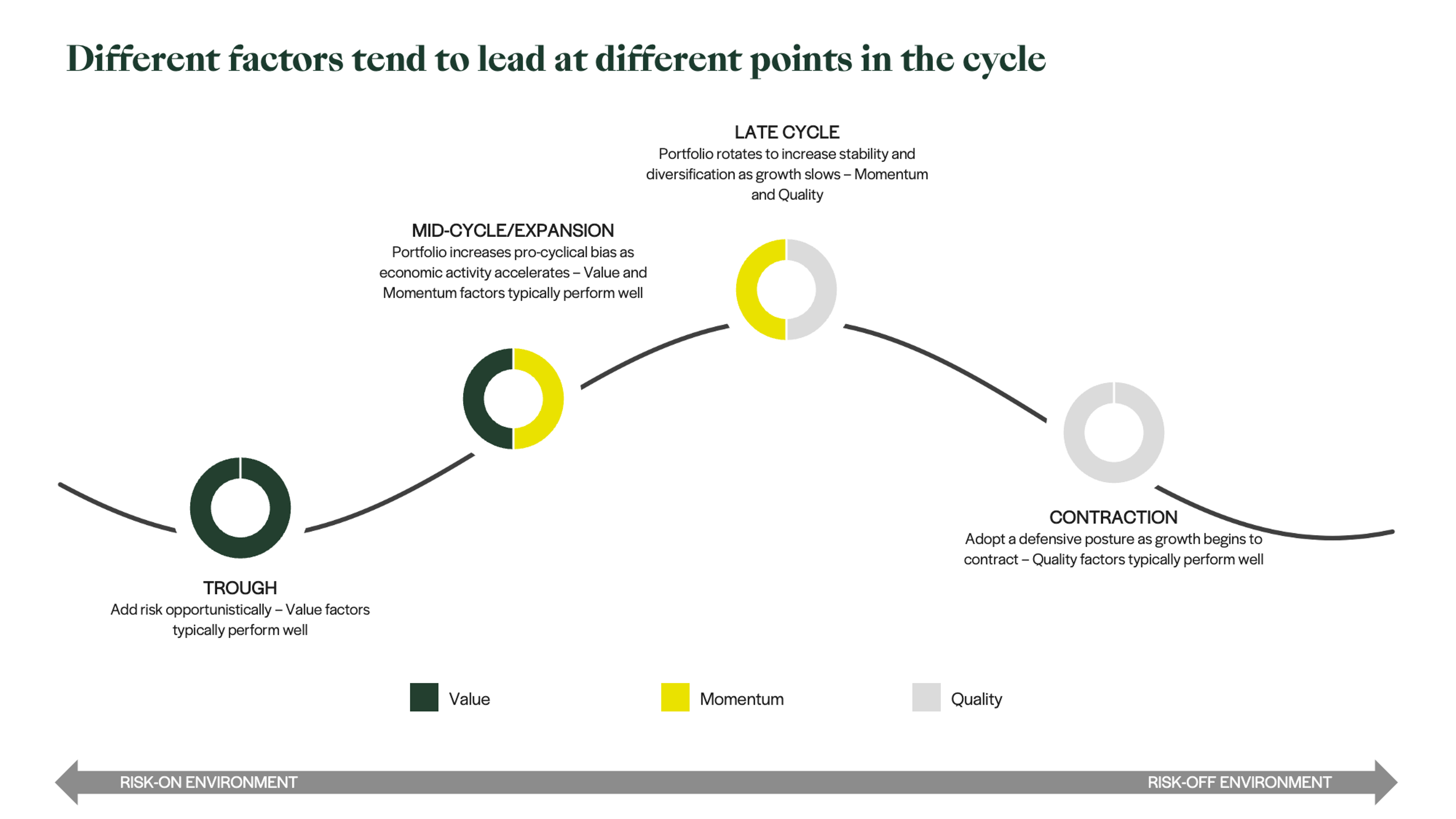
The chart below shows how different factors can take turns leading the market as economic conditions change (aka ‘the cycle’). Value often performs well during periods of recovery, Momentum can benefit when market trends gather pace, and Quality tends to provide resilience when growth slows or uncertainty increases.
While all three factors have delivered strong long-term returns, their performance can vary significantly over shorter periods. A factor that has been leading the market for several years can quickly fall out of favour, making it difficult to predict which style will outperform next.

Rather than relying on a single factor or attempting to predict shifts in market leadership, GEDI combines Value, Quality and Momentum exposure in a single portfolio. The aim is to harness the strengths of each factor while reducing the impact of any one style falling out of favour, helping to deliver a smoother and more consistent investment journey over time.
Ultimately, successful investing is not about finding the one factor that will outperform at the current time. It is about understanding the ingredients that drive returns and blending them thoughtfully. Just as a balanced diet is built from a mix of ingredients rather than any single food, a well-constructed factor portfolio can benefit from combining different factors, creating a more resilient foundation for long-term investment success.
Sources: MSCI, 2025 https://www.msci.com/research-and-insights/paper/factor-indexing-through-the-decades.
Thinking Ahead Institute, 2018 https://www.thinkingaheadinstitute.org/research-papers/investing-in-equity-factors-for-the-long-run/
Disclaimer
The information and opinion contained in this article should not be treated as a forecast, research or advice to buy or sell any particular investment or to adopt any investment strategy and are presented for information only. Any views expressed are based on information received from a variety of sources which we believe to be reliable but are not guaranteed as to accuracy or completeness by atomos. Any expressions of opinion are subject to change without notice.
Past performance is not a reliable indicator of future results. Investing involves risk and the value of investments, and the income from them, may fall as well as rise and is not guaranteed. Investors may not get back the original amount invested.
If you have recently inherited a lump sum and are considering investing it, we can offer guidance.
The value of investments and any income from them can fall and you may get back less than you invested.