04 Jun 2026

The Hidden Cost of Being ‘Too Cautious’

The thought of losing money can be a primary driver when it comes to investment decision making. When people think of risk, in terms of investing, it almost always means seeing the value of their money going down. After all cash in the bank does not go down in value, right?

Investment

Paul Stevens

Senior Portfolio Manager

The Hidden Cost of Being ‘Too Cautious’

The thought of losing money can be a primary driver when it comes to investment decision making. When people think of risk, in terms of investing, it almost always means seeing the value of their money going down.

It boils down to a fear that it could be worth less now than when you started or ‘you may not get back part of your initial investment’, meaning we can’t do what we want with it in the future. After all cash in the bank does not go down in value, right?

These emotions can be even more heightened when you have the responsibility of looking after someone else’s money, in the form of a charity or trust.

But what does that safety of cash in the bank cost us in reality and can we challenge our perception of what risk actually means?

Keeping money in the bank may seem like the safe choice, after all it won’t go down. £100 will still be £100 in 5 years’ time (and if you are lucky you may get a bit of interest on top of that in exchange for giving up access to it for a fixed period). However, what happens if the plans you had your eye on have become more expensive, what if it is now going to cost you £150? You can no longer afford it, or you have to spend more cash than you planned. 

The rate of inflation – the rate of increase in prices, has eroded the value of your cash in the bank. The years since 2022 (to the end of April 2026) are a recent example of the power of inflation. It may have seemed that 4-5% interest from the bank was a good return and compared to the last 10 years even reasonably attractive, but in reality, if prices are rising then your money will have still been losing value. In ‘nominal terms’ (the number of pounds in your account) your cash was increasing in value as it grew by 4% each year, but in ‘real terms’ (what those pounds will actually buy you) its value was falling, due to the impact of inflation.

Over that period, since the start of 2022, UK prices (measured by CPI) increased by 23.5%. Compare that to the return of 18% you would have got on cash held in the bank and remember interest rates were at the highest levels for 15 years over that time. Then compare that to the 56.5% return of a global equity index such as the MSCI world. Money invested in the shares of global companies would have generated 3 times the return of cash.

What this means is, in 2026 the money held as cash in the bank will not buy you as much as it did at the start of 2022, but money that had been invested over that time will now buy you more.

This is the impact of inflation and makes it the number one risk to our future financial goals, highlighting the not always immediately obvious risk - inflation is the real enemy. There is therefore a risk that being over cautious with the assets that we have, although feeling like a safe and prudent decision, can negatively impact our longer-term goals or the impact that this money can have in the future. Indeed, there is a longer-term cost to being over cautious; being too cautious is itself a risk!

We have to ask ourselves; do we have longer term goals that are likely to be impacted by inflation (very few are not) and do we need to do something now to mitigate against it?

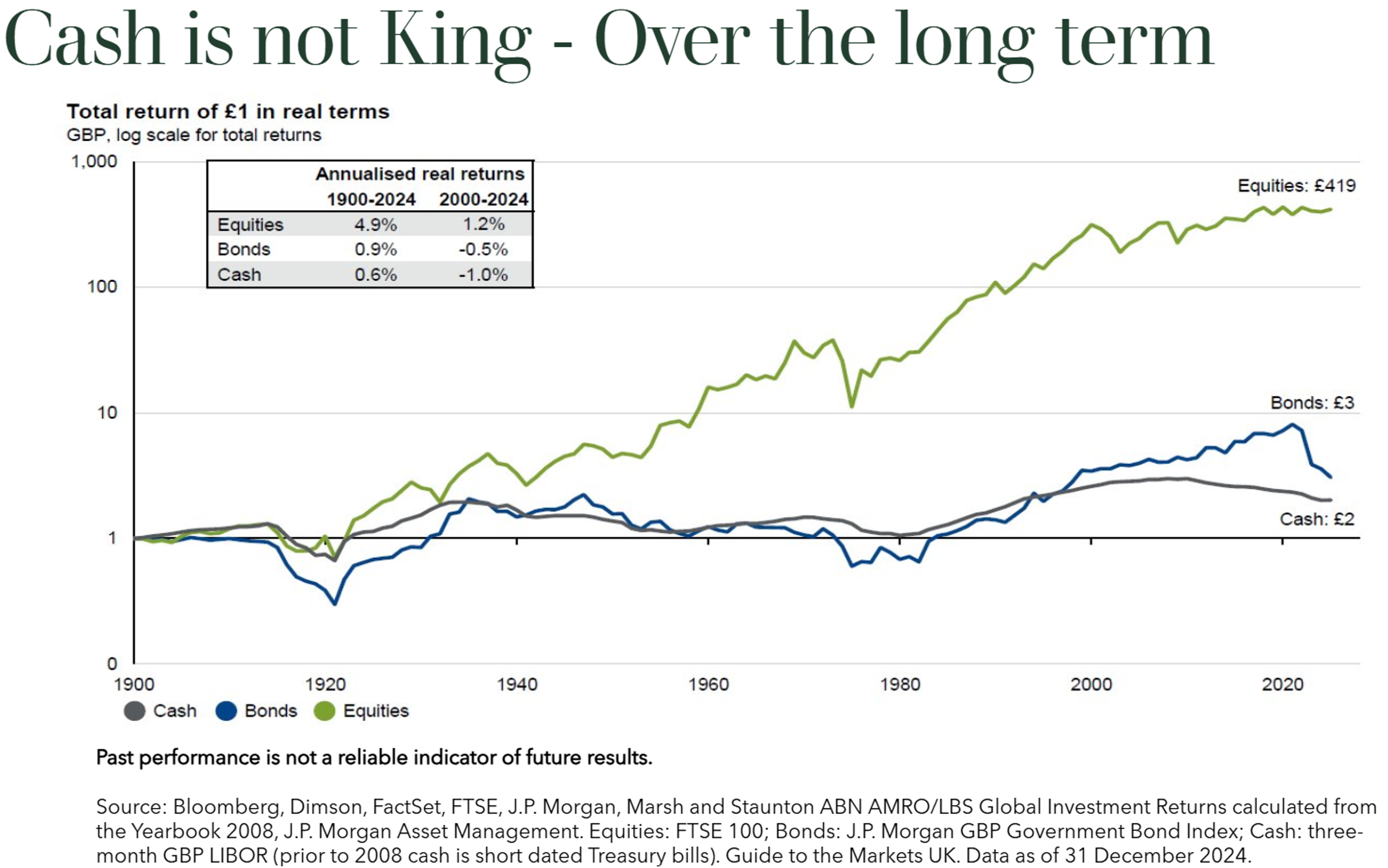
The below chart shows what would have happened in real terms (taking inflation into account) to £1 invested over the last 120 years. It shows that only equities have managed to deliver the sort of returns that will beat inflation.


So that’s the answer, invest your cash! Unfortunately, it is not that simple because that phrase I mentioned at the start still applies, ‘you may not get back part of your initial investment’. Your capital is at risk when you invest and the nominal value of your assets will fluctuate with the market. There have been times over the last 20 years where the value of shares has fallen dramatically. The 2008 Global Financial Crisis, COVID in 2020 and Donald Trump’s trade tariffs in the spring of 2025 to name a few.

For that reason, it is important to establish how much of your available cash you can afford to invest. We always say that any spending commitments inside the next 5 years should be covered by cash in the bank. However, for longer term objectives we should be thinking about investing as a way of protecting those objectives from the impact of inflation, and our ability to fund them. 

You can read more about the importance of maximising the time that you are invested for in our ‘Time in the market, not timing the market' article here.

There is a lot to consider but you are not alone. Our portfolio managers and financial planners are here to guide you through the process of determining how much you have available to invest and how much risk you should be taking, checking that it is affordable to take the level of risk you need to meet your objectives, or if those objectives need to be altered.

The important thing to remember is it’s never too late to start as the longer you can invest for, the more chance you have of achieving your goals. The key is to select a level of risk that is not going to stress your overall financial circumstances but allows you to combat inflation.

Disclaimer

The information and opinion contained in this article should not be treated as a forecast, research or advice to buy or sell any particular investment or to adopt any investment strategy and are presented for information only. Any views expressed are based on information received from a variety of sources which we believe to be reliable but are not guaranteed as to accuracy or completeness by atomos. Any expressions of opinion are subject to change without notice.

Past performance is not a reliable indicator of future results. Investing involves risk and the value of investments, and the income from them, may fall as well as rise and is not guaranteed. Investors may not get back the original amount invested.

Author

Paul Stevens

Senior Portfolio Manager

Paul is a Senior Portfolio Manager, responsible for managing investments for private clients and trusts. He has been part of the atomos team since 2006, and before then he cut his teeth in financial services at Skandia Life Assurance. Paul is a Chartered Wealth Manager, a mark of industry excellence, and he holds a Masters in Wealth Management.

Charity services

How does atomos work with charities? Who do we currently work with? What is our investment management approach? How do we support trustees?

Close

The value of investments and any income from them can fall and you may get back less than you invested.