15 Jan 2026

Infrastructure: Investing in the Essentials That Keep the World Running

Infrastructure rarely makes headlines, but it quietly powers everyday life – from the electricity in our homes to the data centres behind AI and cloud computing. For investors, these essential assets can also play a valuable role in building resilient, diversified portfolios.

Investment

Infrastructure: Investing in the Essentials That Keep the World Running

Summary:

  • Infrastructure underpins everyday life and modern economies, covering essential services like energy, transport, digital networks and data centres, and offering investors stable, regulated returns.
  • It can strengthen portfolios through resilience and diversification, with steady demand, inflation-linked revenues and low correlation to equities and bonds.
  • AI and digital growth are boosting infrastructure demand, especially for data centres and power networks, adding a long-term growth tailwind alongside its defensive qualities.


Infrastructure rarely makes headlines, but it quietly powers everyday life – from the electricity in our homes to the data centres behind AI and cloud computing. For investors, these essential assets can also play a valuable role in building resilient, diversified portfolios.


What do we mean by infrastructure – and why it’s different

Infrastructure investment is all about investing in companies that deliver essential services such as transport systems, energy facilities and telecommunications. These companies often operate in areas that economists characterise as “natural monopolies” – duplicating networks like power grids or rail lines is inefficient, and usually it doesn’t make economic sense to have multiple airports or toll roads service a specific region or city. 

As a result, these companies are typically subject to close regulatory oversight, designed to protect consumers and ensure fair pricing, while still allowing investors to earn stable, predictable returns.


Why infrastructure matters today

Infrastructure is often associated with roads, bridges, airports and power lines, but in the investment world, it is much broader. Today it includes renewable energy facilities, cloud data centres, and fibre optic networks, which are the backbone of modern economies and digital transformation. Global economic shifts, sustainability goals, and the rise of artificial intelligence (AI) are creating significant demand for these assets.


How infrastructure can strengthen a portfolio
Infrastructure assets can strengthen portfolios through a combination of diversification, resilience, and reliable income. Demand for essential services tends to persist through economic cycles, making infrastructure a relatively stable source of returns.

Many infrastructure businesses also have revenues linked to inflation, providing protection against rising prices, while their relatively low correlation with equities and bonds can help reduce overall portfolio volatility.

atomos gains exposure to infrastructure through listed investments – investing in shares of infrastructure companies rather than owning physical assets directly. This approach captures the benefits of infrastructure investing while maintaining liquidity and ease of access within portfolios. The allocation provides exposure to resilient, inflation-linked assets that are well positioned to benefit from long-term structural trends.


How AI Is driving new demand for infrastructure

AI is becoming a dominant theme in corporate strategy, although adoption remains uneven. A record number of companies have referenced AI in recent earnings announcements, highlighting its growing role across areas such as customer engagement, software development, and marketing.

While many firms are still in the early stages of integrating AI into their operations, capital expenditure trends confirm the direction of travel. Hyperscale technology companies are rapidly increasing infrastructure spending, and merger and acquisition activity targeting AI capabilities has accelerated.

For example, in Q3 2025 Nvidia reported record revenue of USD 57.0bn, up 62% year on year, including record Data Centre revenue of USD 51.2bn, up 66%. Demand for its Blackwell AI superchips drove these results, signalling continued confidence in sustained investment in AI-related infrastructure.

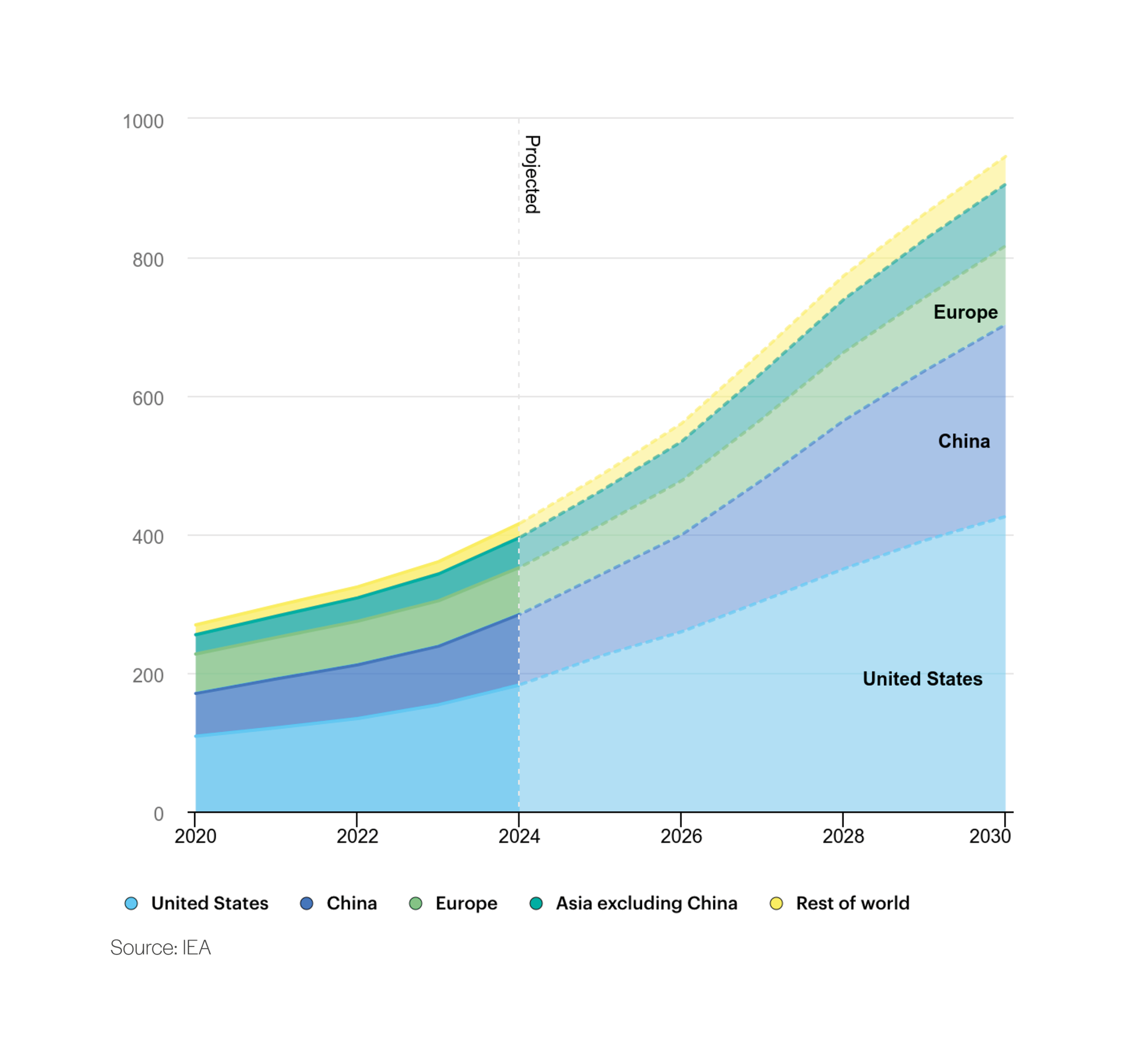
The chart below illustrates projected growth in data centre electricity consumption by region from 2020 to 2030. Consumption increases steadily across all regions, with the U.S. accounting for the largest share, followed by China and Europe. China’s contribution accelerates notably after 2024, reflecting strong projected expansion, while growth in other regions highlights the increasingly global nature of data centre demand.


Understanding the risks

As with any investment, infrastructure carries risks that investors should understand. Large projects can be vulnerable to poor governance and management, leading to cost overruns and delays, which can in turn undermine investment outcomes.

The HS2 rail project illustrates these challenges. Its 2025 “fundamental reset” confirmed that earlier opening timelines could not be met, following years of delays and escalating costs.

Infrastructure assets have also shown sensitivity to extreme events. During the Covid-19 pandemic, transport networks such as airports and international rail lines faced prolonged shutdowns as travel restrictions were imposed. Revenues fell sharply, highlighting how external shocks can disrupt even established assets. Other risks include regulatory changes that alter pricing frameworks, interest rate sensitivity that reduces valuations, and operational challenges such as project delays, cost inflation, or technology failures. 

These risks highlight the importance of careful selection, strong governance, and diversification when allocating to infrastructure.


Managing risk through diversification and discipline

Investors can mitigate risks through diversification and careful portfolio construction. Diversification within infrastructure means spreading exposure across different types of infrastructure assets such as transport, utilities, renewable energy, or digital assets. Each sector responds differently to economic conditions, so combining them helps smooth returns. 

Diversification across asset classes is equally important. Infrastructure tends to perform well during periods of economic stability and when inflation is rising, because many revenues are linked to inflation. However, it may underperform when interest rates rise sharply or regulatory uncertainty increases.

Balancing infrastructure with equities, bonds, and other alternatives ensures portfolios remain resilient in a range of scenarios. By combining infrastructure’s defensive qualities with other sources of growth and income, investors can counteract risks and build portfolios better positioned to withstand volatility.


Summary

Infrastructure provides the foundation for economic growth and remains a valued component of a well-diversified portfolio. For investors, it offers resilience, inflation protection, diversification, and exposure to long term structural themes such as urbanisation, energy transition, and digitalisation. These qualities make infrastructure a durable source of income and stability, independent of short-term market cycles.

While AI is accelerating demand for infrastructure through data centres and advanced networks, the investment case extends well beyond technology. AI may act as a catalyst, but the enduring strength of the asset class lies in its essential role in delivering services that societies cannot function without.

Infrastructure is ultimately about reliability and necessity, making it a core component of a balanced portfolio, with AI-related themes providing an additional tailwind.

Disclaimer

All investment views are presented for information only and are not a personal recommendation to buy or sell. Past performance is not a reliable indicator of future returns, investing involves risk and the value of investments, and the income from them, may fall as well as rise and are not guaranteed. Investors may not get back the original amount invested.

Any views expressed are based on information received from a variety of sources which we believe to be reliable, but are not guaranteed as to accuracy or completeness by atomos. Any expressions of opinion are subject to change without notice.

Are you considering investing?

If you have recently inherited a lump sum and are considering investing it and would like guidance, please click the link below to complete a contact us form and one of our financial planning team will be in touch.

Close

The value of investments and any income from them can fall and you may get back less than you invested.